
Job File
- Address
- Croydon Road, Roleystone WA 6111
- Client
- A Perth renovation builder
- Original brief
- Re-sheet the kitchen ceiling after the strip-out
- Problem found
- Existing ceilings warped and out of level
- Variance
- 40 to 50mm between rooms
- Also found
- Timber wall plates left protruding below the ceiling line
- What we did
- Replaced five ceilings on steel furring channel
- Rooms
- Lounge, master bedroom, two bedrooms, hallway
- Drop
- Approximately 35mm onto the new frame
- Finish
- New Alto cornice throughout
- Completed
- May 2026
AI Overview
A Perth renovation builder asked for a kitchen ceiling to be put back up after their strip-out at a house on Croydon Road in Roleystone. On arrival the job could not be done as asked: timber wall plates were still protruding below the ceiling line where walls had been removed, and the existing lounge ceiling the new kitchen ceiling would have to meet was old, warped and badly out of level, varying by 40 to 50 millimetres between rooms. Sheeting new plasterboard onto joists that far out would have warped the new board and put it back on the floor within a few years, so the one-for-one replacement was declined. Instead the ceilings across the lounge, master bedroom, two secondary bedrooms and the hallway were taken down and replaced, dropped roughly 35 millimetres onto a straight steel furring channel frame, with new Alto cornice throughout.
Key highlights
- ›The job as briefed could not be done properly, so it was not done as briefed
- ›Existing ceilings varied by 40 to 50mm between rooms
- ›Timber wall plates were still hanging below the ceiling line after wall removal
- ›Five ceilings replaced: lounge, master, two bedrooms and hallway
- ›Dropped around 35mm onto a straight steel furring channel frame
- ›Boarding onto joists that far out of level puts a new ceiling on the floor in a few years
 Diagram
What Was Asked For
A renovation builder was partway through a job and had stripped out some ceilings. They wanted the kitchen ceiling put back up. On paper it is a straightforward day's work: sheet it, set it, done.
The complication was that the kitchen ceiling did not stop at the kitchen. It ran into the lounge room ceiling, which was original and had not been touched.
What We Found
Two things, and either one on its own would have been enough to stop the job.
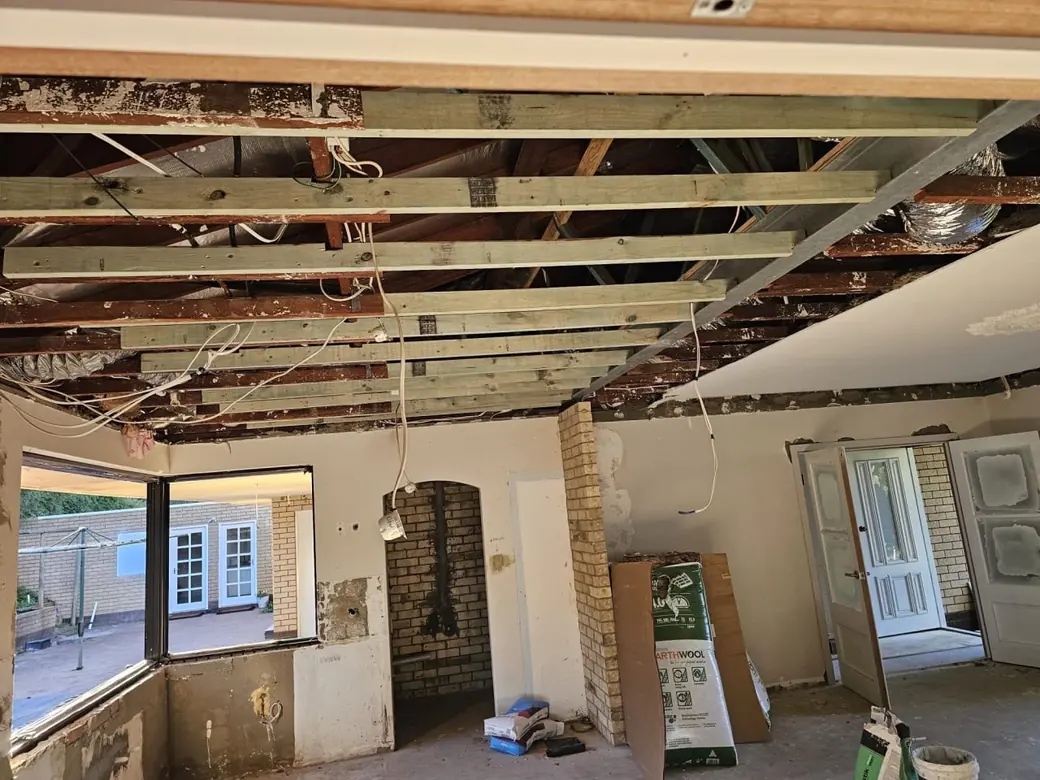
First, walls had been taken out during the renovation and the timber wall plates were still there, hanging below the line the new ceiling needed to run along. There was physically no clean plane to sheet to.
Second, and more seriously, the existing ceilings were old, tired and well out of level. Measured across the rooms, the variance ran to 40 or 50 millimetres. That is not a house settling slightly. That is a difference you can see standing in the doorway.
| Found on arrival | Consequence if ignored |
|---|---|
| Timber wall plates protruding below the ceiling line | No flat plane to fix new board to |
| 40 to 50mm level variance between rooms | New sheet forced to follow the warp, stressed from the day it goes up |
| New kitchen ceiling meeting an untouched old lounge ceiling | A visible step and a joint that never sits right |
Why We Said No
Plenty of outfits would have sheeted it. The board goes up, it looks acceptable on handover day, everyone gets paid.
What happens next is the problem. Fixing plasterboard to joists that are 40 to 50 millimetres out forces the sheet to bend to follow them. The board is under stress from the moment it goes up, the joints work against each other, and in three or four years you have a new ceiling on the floor. The homeowner has then paid twice, and the second time includes the clean-up.
“We could have put it up. It would have looked fine for about three years, and then it would have been on the floor.”
It was a more expensive conversation to have on the day than it would have been to just do what was asked. It is a considerably cheaper conversation than the one after the ceiling comes down.
What We Did Instead
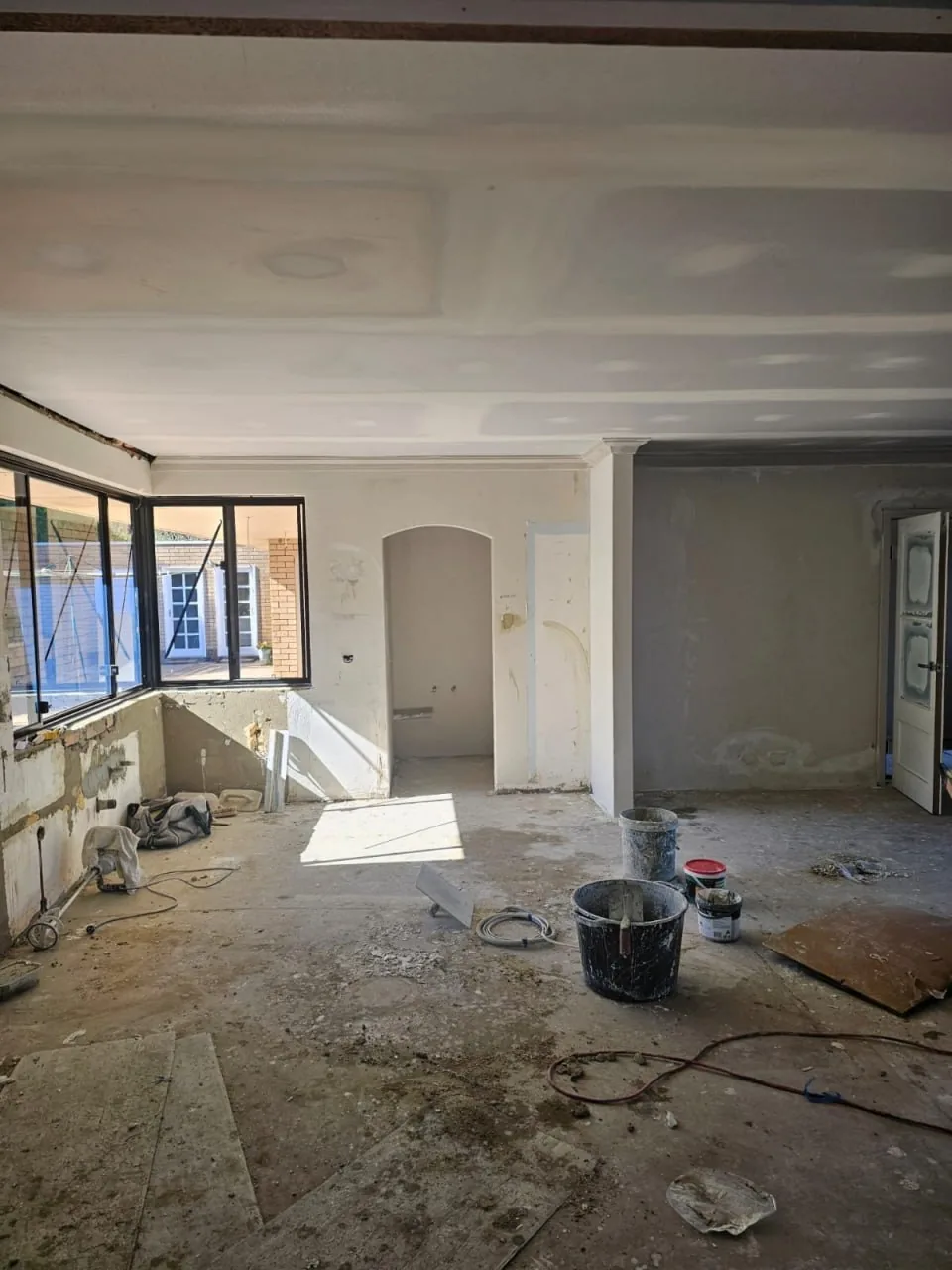
The scope changed from one kitchen ceiling to five ceilings: lounge, master bedroom, two secondary bedrooms and the hallway. Everything came down.
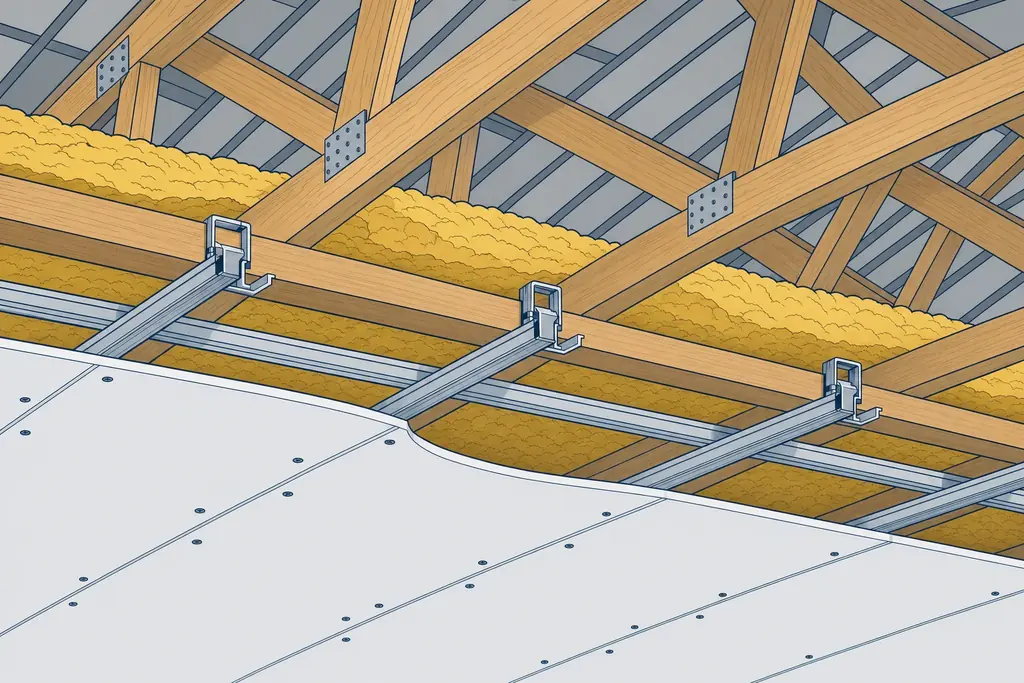
Rather than fight the existing joists, the whole ceiling was dropped about 35 millimetres onto a steel furring channel frame. Furring channel is set dead level independently of whatever the timber above it is doing, so the new plasterboard is fixed to a straight plane instead of a wavy one. It costs more than sheeting straight to the joists and it is the only way to get a flat ceiling in a house that has moved.
New Alto cornice went in throughout to finish the junction between the new ceilings and the existing walls.

Strip out
The old ceilings came down across all five rooms, including the protruding wall plates that had been left behind.

Set the frame
Steel furring channel installed dead level, roughly 35mm below the original ceiling line, independent of the out-of-level joists.

Sheet and set
New plasterboard fixed to a straight plane rather than forced to follow the old timber, then flushed and sanded.

Cornice and finish
New Alto cornice throughout, tying the new ceilings into the existing walls.
The owners here had already spent well into six figures on the wider renovation. The ceiling is the surface nobody plans for and the first thing the eye goes to when you walk into a room, so a warped one quietly undoes a lot of expensive work below it.
Photos From The Job
The lounge with the old ceiling out. The timbers above are what the new frame gets levelled off. The same room from the same side, on a new steel-framed ceiling. Taken from a step further back. The old ceiling coming down, sheet and all. Back to bare roof timbers. This is what a new frame levels off. Debris from the strip-out, with the brick back to bare. Cut back around a vent to see what was above it. Rafters above a nib wall, ceiling gone. The new ceiling set across the open-plan living area. A new hallway ceiling going in overhead. A recessed panel and downlight in the new hallway ceiling. New bedroom ceiling with the downlights cut in. A bedroom back to a flat ceiling and a clean cornice line. New Alto cornice where it meets a pilaster. The hallway, with the brick feature wall kept. New ceiling and cornice at the sliding doors. The new kitchen ceiling above the cabinetry. New cornice worked around the exposed beam. The new ceiling running through to the arch.
Video From The Job
These clips have no sound. Nothing is wrong with your volume.
Seeing pinhole marks, sagging or a stain on your own ceiling?
Send us a photo and we will tell you what is causing it, and whether it needs replacing or just re-strapping.
Send a photo of your ceiling