
AI Overview
Three ceiling replacement options apply to Perth homes: full plasterboard replacement (standard, 20yr solution), suspended grid ceilings (for commercial or large residential spans where service access matters), and ceiling restrapping (when sheets are still good but the support structure has failed). The right choice depends on the condition of the existing sheets, the use of the space, and the budget.
Key highlights
- ›Full plasterboard replacement is the standard residential solution, sheets out, new strapping, new Gyprock
- ›Suspended ceilings are for commercial and large-span applications, not standard residential
- ›Restrapping is only viable when the plasterboard sheets themselves are in good condition
- ›10mm Gyprock CD is the standard residential specification, 13mm for longer spans
- ›Level 4 set is standard for living areas; Level 5 for premium finishes near raking light
- ›Coastal Perth homes need marine-grade galvanised fixings regardless of which system is used
When a ceiling needs attention, the first decision is which type of replacement is appropriate. Most Perth homeowners default to 'just replace the ceiling' without understanding that there are three distinct approaches, and that choosing the wrong one either costs more than necessary or doesn't address the actual problem.
The three options are: full plasterboard replacement (the standard residential approach), suspended grid ceilings (commercial or large-span applications), and ceiling restrapping (when the plasterboard is still serviceable but the support structure has failed). Each has a specific application, specific limitations, and a specific cost range.
This guide covers what each approach involves, when each is appropriate for a Perth home, and what the material specifications mean for the finished result.
Full plasterboard replacement
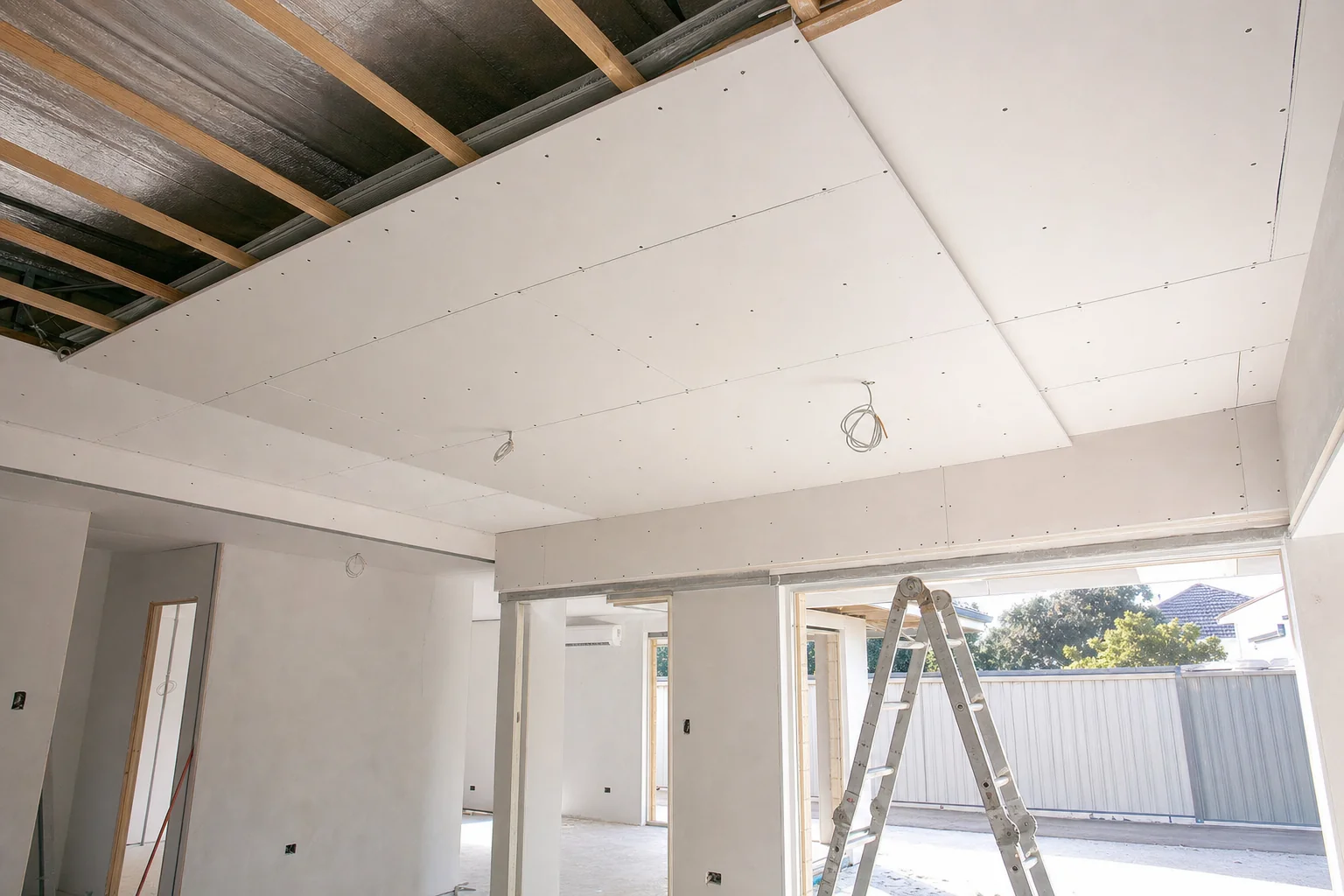
Full plasterboard replacement is the standard residential ceiling replacement approach. The existing plasterboard sheets come down, the strapping (metal furring channel or timber battens) is inspected and replaced where required, and new plasterboard goes up and is set to the agreed finish level.
It's the right approach when: the existing sheets are damaged (water, impact, structural failure), the strapping has failed, or the ceiling has reached the end of its practical life. It produces a flat, clean surface that is paint-ready and will last 20+ years when done correctly.

Strip
Existing sheets removed. Strapping exposed and inspected fully.

Strap
Failed strapping replaced with new galvanised metal furring channel at 450mm centres. Correct strap spacing is critical, wider spacing causes sheet deflection.

Sheet
10mm Gyprock CD for standard spans. 13mm for longer spans. Screwed (not nailed or glued) at code-specified intervals.

Set
Joints, screws and cornice returns set to the agreed level. L4 standard for living areas. Handed over paint-ready.
Suspended grid ceilings
A suspended ceiling (T-bar or grid ceiling) uses a metal grid framework hung from the structural ceiling above, with ceiling tiles dropped into the grid openings. The grid is adjustable in height, making it practical for hiding services (electrical conduit, plumbing, HVAC ductwork) above the ceiling plane.
Suspended ceilings are not a standard residential product in Perth. They're used in commercial fit-outs, home theatres, media rooms, basements (where the structural ceiling is too high), and occasionally in large open-plan living areas where hiding services is a priority.
- You need to hide services above the ceiling level
- You want adjustable ceiling height below the structure
- Commercial or semi-commercial use of the space
- Easy tile-by-tile replacement of sections is a priority
- Acoustic or fire-rated tile specification required
- Standard residential living space, looks commercial
- Ceiling height is already low, grid and tiles take 100–150mm
- You want a flat plastered finish
- The property is residential and you're worried about resale presentation
- Coastal location without appropriate grid corrosion resistance
Ceiling restrapping
Ceiling restrapping replaces the support structure, the furring channel or battens, without removing the plasterboard sheets. It's appropriate when the sheets themselves are in sound condition (no water damage, no delamination, no significant cracking) but the strapping has failed or was incorrectly spaced in the original installation.
The process involves accessing the ceiling cavity and installing new furring channel alongside or over the existing strapping, with the new strap taking the load. In some configurations, the existing sheets are temporarily supported, the strapping replaced, and the sheets re-fastened. In others, a second layer of strapping is installed without disturbing the sheets.
If the plasterboard sheets have bowed, absorbed water, or delaminated, restrapping alone won't fix the visible problem, the sheets need to come out regardless. Restrapping is only viable when a thorough inspection confirms the sheets are still in sound condition.
Comparison: when to use each approach
| Situation | Recommended approach | Why |
|---|---|---|
| Sheets sagging, bowed, or water-damaged | Full plasterboard replacement | Sheets are compromised, strapping only won't fix the visible problem |
| Strapping failed, sheets still sound | Ceiling restrapping | No need to remove serviceable sheets, less disruption, lower cost |
| Asbestos-containing ceiling | Licensed removal + full plasterboard replacement | ACM must be fully removed, cannot be overlined or restrained |
| Commercial or large-span with hidden services | Suspended grid ceiling | Service access and adjustable height are the key requirements |
| Standard residential renovation | Full plasterboard replacement | Standard product, standard finish, best long-term result for residential |
| Single failed strap, sheets otherwise sound | Ceiling restrapping (targeted) | Localised problem, no need to pull the whole ceiling |
Materials in detail, understanding Gyprock specifications
Not all plasterboard is the same. The standard specification for residential ceilings in Perth is 10mm Gyprock CD, 'CD' denoting Ceiling and Damp-resistant grade. This is the correct product for internal ceiling applications in Perth's climate.
| Specification | Use case | Notes |
|---|---|---|
| 10mm Gyprock CD | Standard residential ceilings, spans up to 600mm strap centres | The correct standard product, what we use on most jobs |
| 13mm Gyprock CD | Longer spans, open-plan living areas, strap centres over 600mm | Heavier, more rigid, better deflection resistance on longer spans |
| 10mm Gyprock Aquachek | High-moisture areas, bathrooms, laundries | Not a ceiling product for standard areas, unnecessary elsewhere |
| 19mm Gyprock | Specialist applications, fire rating, acoustic | Not standard residential, adds weight and cost without benefit in normal applications |
Finish levels explained, what Level 3, 4 and 5 actually mean
The AS/NZS 2589 standard defines finish levels for plasterboard installations. The level affects what you'll see in different lighting conditions, and what you pay for the setting work.
Level 3, basic areas
All joints and fasteners filled and sanded. Suitable for areas that will be textured or have limited direct lighting. Garages, storage areas, utility rooms. Not recommended for painted living areas.
Level 4, standard residential
All joints and fasteners filled, taped, and sanded. The standard for painted living areas, bedrooms, kitchens, and general interior spaces. What we specify on most Perth residential jobs.

Level 5, premium finish
Level 4 plus a skim coat applied to the entire ceiling surface. Eliminates any variation in porosity or surface texture. Required for areas with raking light, skylights, large windows, LED strip lighting. Costs 40–60% more than Level 4 for the setting work alone.
If you have LED downlight strips running along the ceiling, a skylight, or floor-to-ceiling windows that create raking light across the ceiling surface, Level 5 is worth specifying. Level 4 on a ceiling with raking light will show every minor variation, telegraphing joints, slight ridges, that would be invisible under standard downlighting.