
AI Overview
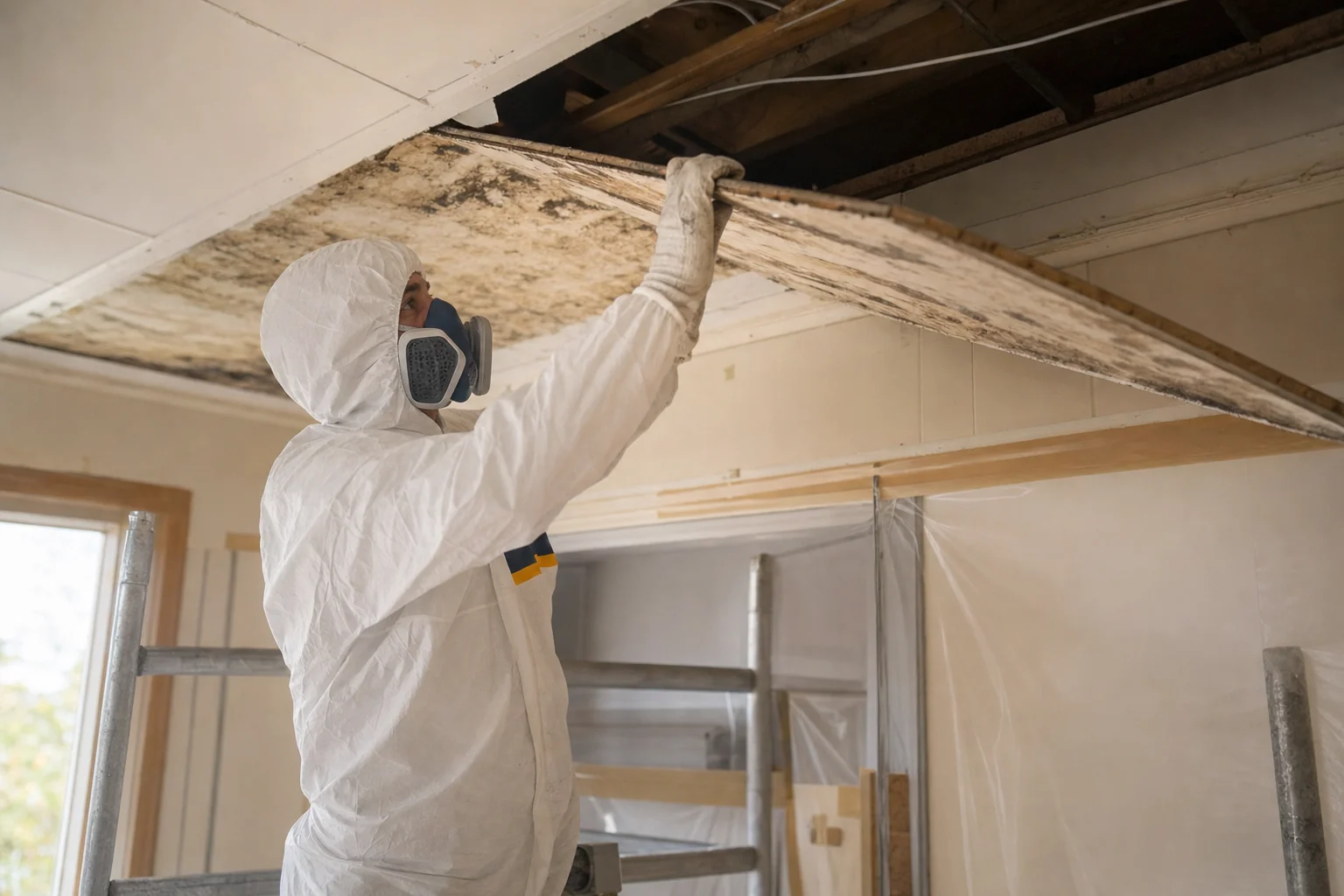
Asbestos-containing ceiling materials were used in Perth homes built before 1985, primarily as textured spray finishes and flat fibre-cement sheets. Safe removal requires a licensed contractor (Class B for non-friable materials), proper containment, and documented disposal. After removal, standard plasterboard replacement follows.
Key highlights
- ›Perth homes built before 1985 may have asbestos in ceilings, textured sprays and fibre-cement sheets are the most common forms
- ›Intact asbestos is not an immediate health risk, disturbing it is
- ›Class B asbestos removal license is required for non-friable (bonded) ceiling materials
- ›An asbestos assessment by an accredited assessor is required before removal
- ›Disposal must go to a licensed asbestos disposal facility with documentation
- ›After removal, standard plasterboard replacement proceeds as normal
Asbestos was widely used in Australian construction from the 1940s through to the mid-1980s. In Perth homes, the ceiling is one of the most common locations for asbestos-containing materials, particularly in homes built or renovated between 1960 and 1985.
The two main forms Perth homeowners encounter are textured spray-applied ceilings (sometimes called 'popcorn' or 'acoustic' ceilings) and flat fibre-cement sheets. Both can contain asbestos. Neither is dangerous if left intact. Both become a hazard when disturbed.
This guide covers how to identify whether your Perth home might have asbestos in the ceiling, what the licensed removal process involves, and what to expect when the ceiling is replaced afterwards.
What asbestos ceiling materials look like
Asbestos-containing ceiling materials in Perth homes come in two main forms. The first is the textured acoustic spray, a rough, bumpy surface that was applied directly to the ceiling substrate. It was used as a decorative finish and for acoustic dampening. The second is flat fibre-cement sheeting, smooth or lightly textured sheets that look similar to modern plasterboard but are heavier and more rigid.
| Type | Appearance | Common era | Asbestos content |
|---|---|---|---|
| Textured spray ('popcorn') | Rough, granular, bumpy surface | 1960s–1980s | 2–6% chrysotile (white asbestos) in most cases |
| Flat fibre-cement sheet | Smooth/flat, heavier than plasterboard | 1940s–1980s | 10–15% chrysotile typical |
| Fibrous plaster (lath backing) | Lime plaster with hessian reinforcement | Pre-1940s–1960s | Generally no asbestos, pre-dates widespread use |
| Vinyl ceiling tiles | Square tiles, often glued direct | 1960s–1970s | Some contain asbestos in the backing or adhesive |
Fibres are microscopic. A ceiling that looks fine may contain asbestos; a ceiling that looks suspect may not. The only definitive identification is a bulk sample test by an accredited assessor (NATA-accredited laboratory). Do not assume either way.
Which Perth homes are affected
The practical rule for Perth homeowners is: if your home was built before 1985 and the ceiling has never been replaced, assume asbestos may be present until an assessment proves otherwise. The ban on asbestos in new building materials came into effect progressively through the late 1980s, with the definitive prohibition on chrysotile in 2003.
Older suburbs in Perth's inner and middle ring, Morley, Stirling, Fremantle, Canning, have significant concentrations of pre-1985 housing stock. We encounter asbestos ceiling assessment requirements regularly across all eight of the suburbs we cover.
Is it dangerous to leave asbestos ceilings alone?
Intact, bonded (non-friable) asbestos-containing ceiling material in good condition is not an immediate health risk. Asbestos fibres are only hazardous when they become airborne, which happens when the material is disturbed, damaged, cut, sanded, or drilled.
A textured spray ceiling that is sound and in good condition can be left in place indefinitely. The risk assessment changes when: the ceiling is damaged or deteriorating (fibres can become loose), you're planning renovation work that would disturb the ceiling, or you want to replace it for other reasons (water damage, structural failure, renovation).
“Asbestos in good condition: not an immediate risk. Asbestos being cut, drilled, sanded, or broken: that's the hazard. The material is safe until someone decides to disturb it.”
The licensed removal process, what actually happens

Accredited assessment
An asbestos assessor (accredited under state regulation) takes a bulk sample and sends it to a NATA-accredited laboratory. Results confirm whether ACM is present and identify the fibre type. The assessor provides a written report. This is required before any removal work begins.

Notification to WorkSafe WA
For removals over 10 square metres, WorkSafe WA notification is required under the Work Health and Safety (Asbestos) Regulations. The licensed contractor handles this.
Containment and PPE
The work area is contained with plastic sheeting. Adjacent areas are sealed. Workers wear Class P2 (or P3 for friable) respirators, disposable coveralls, and appropriate PPE. The work area is under negative pressure for friable materials.

Careful removal
Non-friable ACM (bonded asbestos in sheets or spray) is removed using wet methods to suppress fibre release. Material is not broken unnecessarily, large sections where possible.
Decontamination
The work area is cleaned using HEPA vacuum and wet methods. Disposal bags are double-bagged, labelled with asbestos disposal labels, and sealed. Workers decontaminate before leaving the work area.

Licensed disposal
Asbestos waste is transported to a licensed asbestos disposal facility. Waste disposal documentation (weighbridge docket or facility receipt) is retained. We provide copies to the client.
What happens after asbestos removal
Once the asbestos-containing material is removed and the area is cleared and decontaminated, ceiling replacement proceeds exactly as it does on any non-asbestos job. The substrate (rafters, any remaining strapping) is inspected. New metal furring channel is installed at the correct centres. Standard 10mm Gyprock CD is installed, screwed to the strapping, and set to the agreed finish level.
There's no additional lead time for the plasterboard work after the removal phase, we schedule it as a sequential operation. The whole project, assessment, removal, and replacement, is managed under one scope of works.
Cost of asbestos ceiling replacement in Perth
| Phase | Typical cost range | Notes |
|---|---|---|
| Asbestos assessment (per property) | $300–$600 | Accredited assessor, NATA lab analysis, written report |
| Class B removal (per room) | $800–$2,500 | Containment, removal, decontamination, disposal |
| New plasterboard ceiling (per room) | $450–$900 | 10mm Gyprock CD, L3-L4 set |
| Total per room (assessment + removal + replacement) | $1,200–$3,500 | Wide range, ceiling area and complexity |
| Whole house (3-bed, full asbestos) | $6,000–$14,000+ | Area, accessibility, and disposal volume drive variation |
Assessment costs are separate and paid to the accredited assessor regardless of whether asbestos is found. Removal costs vary significantly based on ceiling area, level of contamination, and site accessibility.
Why DIY asbestos removal is not an option
In Western Australia, the removal of asbestos-containing material from residential premises requires a Class B (bonded asbestos) removal licence. Unlicensed removal is an offence under the Work Health and Safety Act 2020 (WA) with penalties for individuals and companies.
Beyond the legal requirement, improper asbestos removal carries long-term health consequences. Mesothelioma, the cancer linked to asbestos exposure, has a latency period of 20–50 years. The person who removed the ceiling in 2026 may not see the consequence until 2046 or later.
We don't work on ceiling replacements where a previous unlicensed removal has been carried out without clearance documentation. If someone has already removed what looks like asbestos ceiling material without documentation, you need a clearance inspection by an accredited assessor before any further work can proceed.